Nikita Juneja has written extensively about decisions made by the Supreme Court.
In a country where conversations about women’s bodies have long been mired in social taboo and legal ambiguity, the Supreme Court of India has moved decisively toward clarity and compassion.
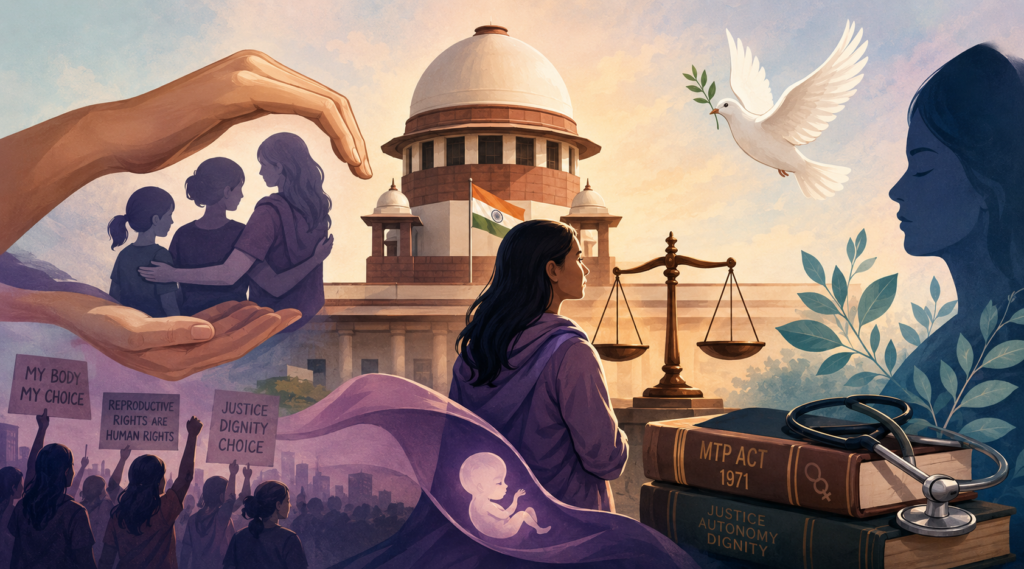
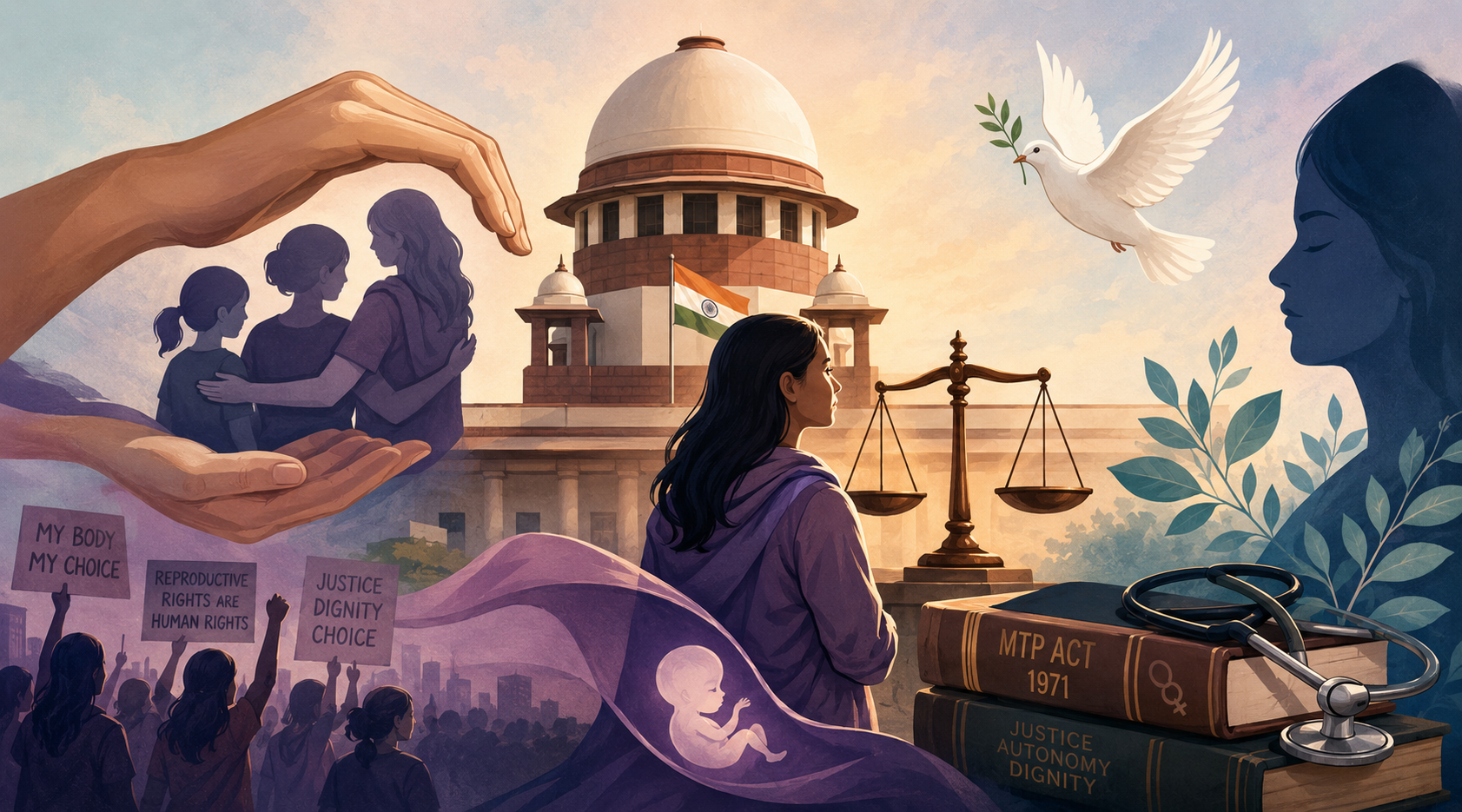
Earlier this month, the Court made a significant oral observation: the Medical Termination of Pregnancy (MTP) Act, 1971 may need to be amended to remove statutory time limits for terminating pregnancies resulting from the rape of minors. The observation arose while dismissing a curative petition involving a 15-year-old rape survivor’s 30-week pregnancy termination. The Supreme Court reinforced a principle that lies at the heart of reproductive rights the decision rests with the survivor and her family, not the State.
This is not merely a legal development. It is a turning point in how India’s justice system understands the intersection of trauma, bodily autonomy, and the law. Importantly, conversations about the Supreme Court’s evolving role have sparked national debate.
Understanding the MTP Act: A Brief History
The Medical Termination of Pregnancy Act, 1971, was a landmark piece of legislation for its time. Framed on the recommendations of the Shantilal Shah Committee (1964), it was introduced primarily to address the alarming rate of maternal mortality caused by unsafe, illegal abortions across the country.
The original Act permitted termination by a registered medical practitioner under specific conditions to save the life of the pregnant woman, in cases of rape or incest, or due to contraceptive failure (limited, at the time, to married women). A strict 20-week gestational limit governed all terminations.
The 2021 Amendment updated this framework significantly:
- The upper gestational limit was raised from 20 to 24 weeks for special categories, including rape survivors, minors, victims of incest, and women with disabilities.
- The contraceptive failure clause was extended to unmarried women, closing a glaring legal gap.
- For pregnancies with substantial fetal abnormalities diagnosed by a Medical Board, no upper limit applies.
- Terminations up to 20 weeks require the opinion of one doctor; between 20 and 24 weeks, two doctors must concur.
The 2021 amendment was widely acknowledged as progressive — but as the Supreme Court’s recent observation makes clear, the law still has ground to cover.
Why the Court’s Observation Is Significant
The existing 24-week limit, while an improvement, does not account for the realities that survivors, especially child survivors face.
A minor who has been raped may take weeks or months to come forward. She may not understand what has happened to her. Her family may be navigating trauma, shame, fear of social stigma, or a slow-moving legal system. By the time a case reaches medical or judicial attention, the window permitted under current law may already be closing or already closed. Furthermore, the Supreme Court often has to address these gaps in urgent hearings.
In such scenarios, the law as it stands does not protect the survivor. It burdens her further. The Supreme Court’s recognition of this gap, and its suggestion that Parliament revisit the time limits for minors who are rape victims, reflects a judiciary that is listening to the lived realities of those most vulnerable to systemic failure.
Reproductive autonomy which is the right of a person to make decisions about their own body is not a peripheral concern. It is recognized by the Supreme Court itself, in judgments including the landmark X v. Principal Secretary, Health and Family Welfare Department (2022), as a dimension of the constitutional right to life and personal liberty under Article 21.
Compelling a child who has survived rape to carry a pregnancy to term is an active harm, one that the State inflicts by inaction. Removing the gestational limit in such cases would not expand abortion access broadly; it would simply ensure that the most vulnerable are not trapped by procedural timelines. Clearly, the Supreme Court’s stance was a critical factor in this development.
What Needs to Follow
The Court’s observation is not binding law, it is a judicial signal, directed at the legislature. For it to translate into change, several steps must follow.
Legislative Amendment: Parliament must act on the Supreme Court’s suggestion and amend the MTP Act to remove time-based restrictions in cases of rape of minors. The amendment should be specific, carefully drafted, and accompanied by clear Medical Board guidelines to prevent misuse while ensuring access.
Faster Medical Boards: One of the most documented barriers to abortion access in India is institutional delay. Women who require Medical Board approval, particularly in cases beyond 20 weeks, frequently lose their legal window while waiting for Boards to be constituted. Streamlining this process is not optional; it is urgent.
Awareness and Access: Legal rights are meaningless without access to information and services. Large sections of India’s population, particularly in rural and semi-urban areas, remain unaware of what the MTP Act permits. Healthcare infrastructure, trained providers, and public legal literacy must be strengthened alongside legal reform.
Destigmatization: Law reform, however progressive, operates within a social context. Abortion continues to carry significant stigma in India, stigma that deters women and families from seeking timely care. Medical professionals, policymakers, and civil society all have a role in normalizing abortion as healthcare, not as a moral failing.
A Step in the Right Direction
The Supreme Court’s observation on the MTP Act reflects a judiciary willing to look squarely at a gap in the law and name it. It affirms that a child rape survivor’s bodily autonomy cannot be subordinated to a statutory timeline, and that the State’s role is to protect her, not to override her.
Progress in law is rarely linear, and rarely fast. But this moment, a court saying that the law must do better for its most vulnerable is the kind of progress worth recognizing and building upon. In summary, the Supreme Court has demonstrated a pivotal influence on India’s reproductive rights legislation.
The legislature now has both the direction and the moral imperative to act.